







Every relationship experiences conflict. Whether you’re disagreeing about communication, finances, parenting, household responsibilities, or unmet expectations, occasional arguments are a natural part of sharing your life with someone.
What matters most isn’t whether conflict happens, but how you manage conflict in a relationship. When handled with empathy, respect, and healthy communication, disagreements can strengthen trust, deepen emotional connection, and help you better understand each other’s needs.
But when the same arguments happen over and over, it’s easy to feel like you’re on opposing sides. Conversations can become less about solving the problem and more about proving who’s right. Over time, this can leave both partners feeling unheard, disconnected, and emotionally exhausted.
The good news is that healthier patterns can be learned. In this guide, you’ll learn why relationship conflict happens and how to recognize healthy and unhealthy conflict. You’ll also discover practical therapist-recommended strategies for managing disagreements, along with when couples therapy can help you reconnect and move forward together.
What Is Conflict Management in Relationships?
Conflict management in relationships is the process of handling disagreements in a constructive way that strengthens the bond between partners. It’s a mutual agreement on how to navigate difficult conversations without causing additional hurt, ensuring that both individuals feel respected and cared for, even during a dispute.
Healthy conflict feels like you’re sitting on the same side of the table, looking at a problem together. You stay curious about each other’s feelings and can slow down when things get heated. It’s a process that leaves you both feeling heard, respected, and ultimately, more connected than you were before.
Unhealthy conflict, on the other hand, feels like a battle. It’s filled with blame, score-keeping, or one of you shutting down completely. Instead of solving a problem, it creates new wounds, pushing you further and further apart.
And if you feel exhausted by all of this, please know that feeling is real. Unresolved conflict creates a constant state of stress that slowly wears away at the trust and closeness you share. It’s a quiet poison that, over time, can damage the very foundation of safety that your relationship is built on.
Why Does Conflict Arise in Relationships?
It can be so frustrating to feel stuck in the same argument, never getting anywhere. The reason it feels like you’re going in circles is that the surface issue, like who forgot to take out the trash, is rarely the real issue. Conflict is almost always a signal that something deeper and more important needs your attention, usually growing from one of these very normal, human roots:
- Communication Gaps & Unmet Needs: Many fights begin with a simple miscommunication or a moment when one partner feels unseen, unheard, or unappreciated.
- Everyday Stress: The pressures of work, finances, and just life in general can leave you both feeling drained, making it easy to be short-tempered with the person you love most.
- Our Personal Histories: We all learn how to handle conflict from our earliest relationships. Our unique personalities, emotional triggers, and attachment styles significantly influence how we engage in arguments.
And if communication feels like the biggest hurdle, you are not alone. In studies of divorced couples, a majority cite “too much conflict and arguing” as a major reason their relationship ended. A clear sign that learning to manage it is one of the most important things you can do.

Turn Conflict Into Connection
Disagreements don’t have to push you apart. With the right support, you can learn to navigate tough moments and grow closer through them.
How Can Healthy Conflict Strengthen a Relationship?
A truly strong relationship isn’t one that avoids conflict; it’s one that has learned how to use conflict to grow closer. It’s a hard thing to remember when you’re in a painful moment, but disagreements don’t have to be destructive. In fact, they can be the very thing that makes your bond stronger. When you learn to navigate disagreements with kindness, you send a powerful, unspoken message to each other: “Even when we see things differently, we are still a team. You are still safe with me.”
Each time you successfully repair a moment of tension, you build a little more trust. You learn more about each other’s needs, fears, and dreams. Addressing issues early, before they have a chance to grow into deep resentments, keeps your relationship feeling fresh, honest, and alive.
Of course, learning to do this on your own, especially when you’re feeling hurt, can be incredibly challenging. For many couples, working with a professional in marriage counseling is what truly helps transform these painful moments into real, lasting connections.
What Are the Most Effective Conflict Management Strategies?
When a conversation starts to get tense, it can feel like you’re lost in the woods without a map. The following strategies are like a simple, reliable compass to guide you back to safety and connection. These are not complicated rules, but clear, practical steps that can help you navigate difficult moments with more kindness and less hurt.
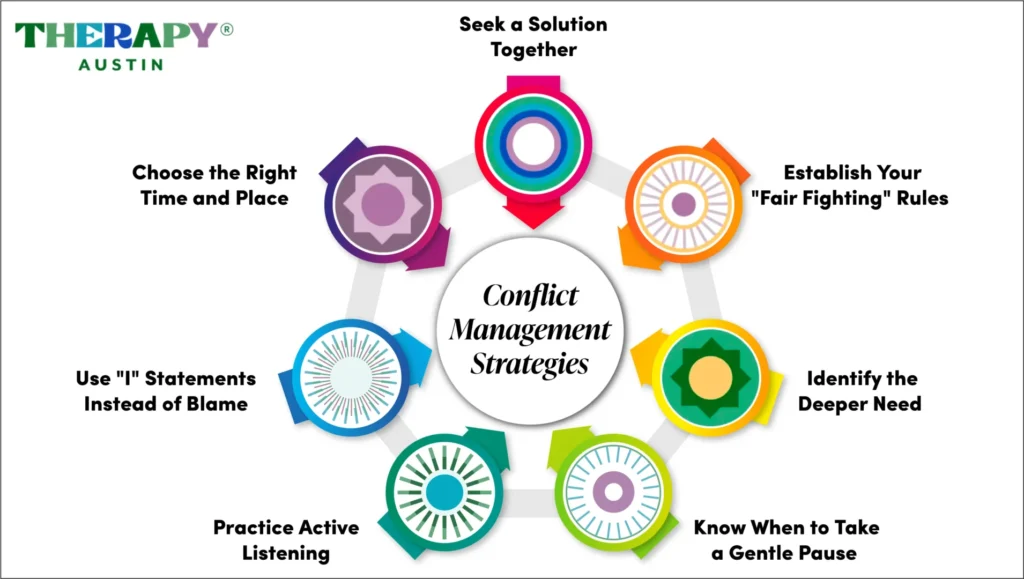
Practice Active Listening
Active listening goes far beyond just hearing the words your partner is saying. It’s the gentle work of listening for the feelings behind the words. It’s about setting aside your own defenses to make your partner feel truly seen and heard. You can do this by:
- Mirroring: Gently repeat back what you heard them say. “So, what I’m hearing is that you…”
- Summarizing: “It sounds like the most important part of this for you is…”
- Validation: “I can see why you would feel so frustrated by that. It makes sense.”
Use “I” Statements Instead of Blame
Previously, while discussing communication exercises for couples therapy we’ve learned that nothing shuts down a conversation faster than blame. When your partner hears “You always…” or “You never…”, their walls immediately go up, and the chance for connection is lost. The simplest way to keep the conversation safe is to speak from your own experience.
- Instead of: “You always ignore me.”
- Try: “I feel unheard when we’re both on our phones. Could we try to put them away during dinner?”
This small change can make a world of difference.
Know When to Take a Gentle Pause
Have you ever been in a fight where your heart starts racing, your vision gets narrow, and you can’t think straight? That’s called “emotional flooding.” When this happens, no productive conversation is possible.
Taking a time-out isn’t about punishing your partner, it’s an act of love for your relationship. Agree to pause the conversation for at least 20 minutes and take a moment to calm down before resuming.
Identify the Deeper Need
Most arguments are not about what they seem to be about. A fight about washing the dishes is rarely just about the dishes. It’s usually about a deeper, unmet need. A need for respect, for support, for rest, or for feeling like a priority.
Try to look beneath the surface issue and ask, “What is the feeling here? What is the real need?”
Establish Your “Fair Fighting” Rules
Sit down together during a calm moment and agree on a few simple rules for when things get tough. This is your shared promise to protect each other and your relationship, even when you’re upset. Common rules include no name-calling, no raising your voice, and no bringing up old, resolved issues.
Choose the Right Time and Place
Don’t try to have a difficult conversation when you’re exhausted, rushing out the door, or distracted by the kids. Find a quiet moment when you can both give the conversation the calm, focused attention it deserves.
Seek a Solution Together
The goal is not for one person to “win” the argument. The goal is for the relationship to win. Frame the problem as something you are tackling together, as a team. Ask, “How can we solve this?” This simple shift changes everything.
When Should You Seek Professional Help?
Sometimes, even with the best intentions, you can get stuck. If you find yourselves having the same painful fight over and over, or if one of you has started to shut down completely, it may be time to bring in a gentle guide. When contempt or emotional withdrawal has entered your relationship, it’s a clear sign that you need support.
If conflicts seem to repeat despite your best efforts, our couples therapy services in Austin offer a safe space to rebuild understanding and connection.
How to Maintain Healthy Habits for the Long-Term
Learning these new ways of communicating is like learning a new language. At first, it can feel a little awkward, and you have to think about every word. But with daily practice, this new, kinder way of talking to each other becomes your natural language, the one you use without even thinking.
- Have a Gentle Weekly Check-In:Set aside just 20 minutes a week to ask each other: “What went well for us this week?” and “What felt hard?” This simple ritual can prevent small issues from escalating into bigger problems.
- Keep Practicing Repairs: A repair is any small gesture that gets you back on track during a tense moment. It can be as simple as saying, “You’re right,” or “Can we please start over?”
- Fill the Well with Positivity: Make a daily effort to notice the good things. A simple “thank you” or a warm hug can build a deep reserve of goodwill that makes navigating conflict so much easier.
Key Takeaways for a Healthier Relationship
The journey of learning to navigate conflict is one of the most loving things you can do for your relationship. Remember that conflict is normal, and when handled with care, it can be a path to deeper intimacy and trust.
Always try to see the problem as something you are tackling together, as a team. Listen to understand, speak from the heart with “I” statements, and know when it’s time to take a gentle pause.
For couples seeking guided support, our couples therapy helps partners move from conflict toward connection if you reside in Austin, Texas.
Beyond our services, there are other reputable clinics to consider based on your location:
If you are living in Ohio, Colorado, or Kentucky, Mindfully is an excellent option, with more than 16 locations.
If you are looking specifically in Colorado, Ignite Counseling Colorado is a good choice to consider.