







There is a common cultural narrative that portrays couples therapy as the “last stop” before a breakup or divorce. We often imagine a therapist’s office as a place filled with heavy silence, tear-soaked tissues, and two people who can no longer stand to be in the same room. Under this framing, seeking professional help is seen as an admission of failure or a desperate attempt to save a sinking ship.
However, this narrow view of relationship support is a significant misconception that prevents many partners from accessing the tools they need to flourish. In reality, couples therapy is not merely a reactive measure for failing relationships. It is a proactive, growth-oriented practice designed to build resilience, improve communication, and optimize emotional intimacy at any stage of a partnership. Whether you are navigating your first year of cohabitation or celebrating your twentieth anniversary, therapy offers a space to focus on building a resilient partnership rather than just surviving a difficult season.
What Is Couples Therapy and What Does It Address
To understand why therapy is beneficial even outside of a crisis, it is helpful to define what it actually is in a professional context. In a clinical sense, couples therapy is a structured form of psychotherapy focused on improving relational functioning. Unlike individual therapy, which focuses on the internal psyche of one person, couples therapy treats the relationship itself as the client.
The therapist’s role is that of a neutral facilitator. They are not there to take sides or act as a judge in your disagreements. Instead, they work to create a sense of emotional safety where both partners can explore their dynamics with curiosity rather than blame. Through evidence-based models, they help couples regulate conflict, bridge communication gaps, and deepen their understanding of one another.
Measurable Goals of Therapy
Therapy is not just about talking through feelings. It aims for concrete, life-changing outcomes, including:
- Increased relationship satisfaction and joy.
- Reduced frequency and intensity of repetitive arguments.
- Improved emotional safety and a deeper sense of trust.
- Clearer boundaries and a better alignment of shared life goals.
Does couples therapy only treat severe relationship problems?
The answer is no. Couples therapy improves relational functioning at all stages, not only during a crisis. It is as much about relational fitness and maintenance as it is about emergency repair.
What Qualifies as a Relationship Crisis
While therapy is useful for everyone, it is important to distinguish between growth-oriented therapy and crisis intervention. A crisis is generally defined by acute relational instability. This is a point where the usual ways of coping and communicating have completely broken down, leaving the relationship in a state of high stress.
Indicators of a crisis include:
- Arguments that quickly spiral into personal attacks or physical intimidation, leaving both partners feeling unsafe.
- Discovery of betrayal, like infidelity, financial deception, or major breaches of trust, that shatter the foundation of the bond.
- When one or both partners are actively researching divorce or feel they have “one foot out the door.“
Expert framing suggests that a crisis is defined not just by the presence of a problem, but by the loss of repair mechanisms.
Longitudinal marital studies from the Gottman Institute indicate that high-conflict couples show significantly elevated stress biomarkers, including chronically high cortisol levels, and significantly lower relationship satisfaction compared to low-conflict couples. In these cases, therapy acts as a critical intervention to lower physiological stress and stabilize the union so that healing can begin.

Give Your Relationship The Care It Deserves
Explore Therapy Austin’s couples therapy services to address conflict, reconnect emotionally, and strengthen your partnership in a safe, supportive environment.
Can Couples Therapy Be Preventive Instead of Reactive
One of the most powerful arguments for seeking support early is the concept of preventive care. Much like we go to the gym to build strength or visit a doctor for an annual check-up, couples therapy functions as a way to keep a relationship healthy before “symptoms” become severe. You do not wait for a heart attack to start exercising. Similarly, you do not need to wait for a total breakdown of trust to work on your communication.
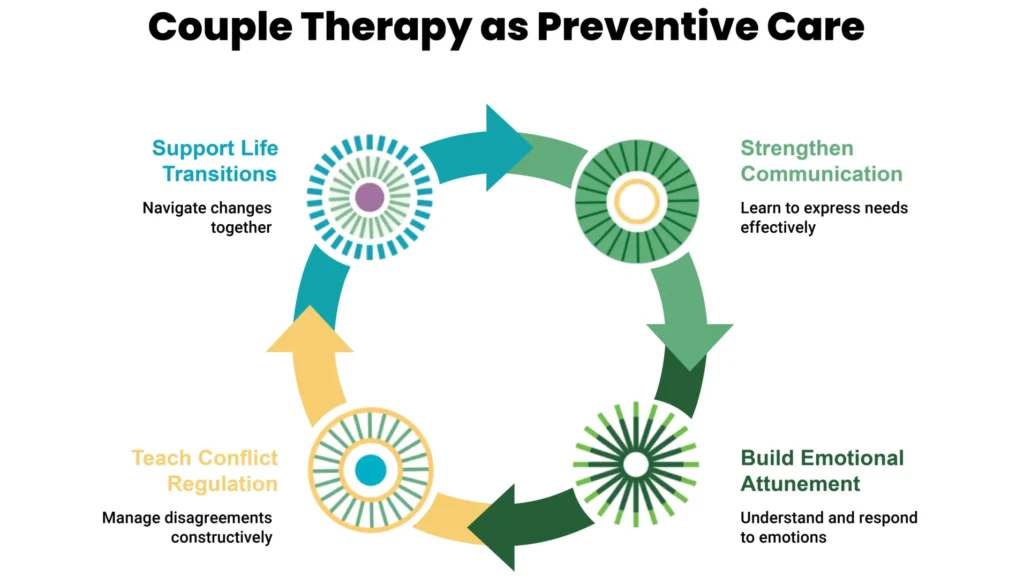
Therapy functions as preventive care by:
- Strengthening communication: Learning how to voice needs and “I” statements before they turn into deep-seated resentments.
- Building emotional attunement: Developing the ability to truly read and respond to a partner’s emotional state effectively.
- Teaches conflict regulation skills: Learning how to disagree without damaging the bond, keeping the mindset of “us against the problem” rather than “me against you.”
- Supporting major life transitions: Proactively navigating shifts such as moving in together, marriage, career changes, or the transition to parenthood.
The data support this early-intervention approach. A meta-analysis published in the Journal of Family Psychology found that premarital counseling is associated with approximately a 30% reduction in divorce risk and higher long-term relationship satisfaction. These couples report greater stability because they entered their commitment with a pre-established toolbox for navigating life’s inevitable challenges.
Why Do People Assume Couples Therapy Is Only for Crisis
If the benefits of early therapy are so clear, why does the “last resort” stigma persist? Several factors contribute to this:
- Cultural framing: Traditionally, therapy has been framed as a problem-solving tool for broken things rather than a gymnasium for emotional strength. We are taught to “fix it” only when it is visibly falling apart.
- The stigma of failure: Many couples feel that seeking help is an admission that they are not “perfectly happy.” There is a fear that telling friends or family they are in therapy will lead others to assume the marriage is ending.
- Lag in mental health normalization: While individual mental health care has become widely accepted and even celebrated, relationship therapy is still catching up in terms of public perception.
By normalizing therapy as a tool for growth, we can shift the narrative from “What is wrong with us?” to “How can we make our connection even stronger?“
How Does Couples Therapy Benefit Healthy Relationships
Even in a relationship without a fire to put out, therapy offers substantial benefits. Healthy couples often use therapy to transition from a “good” relationship to an “exceptional” one. It provides a dedicated, safe space to think beyond the logistics of daily life and focus on the soul of the partnership.
- Improved intimacy and sexual communication: Therapy provides a safe space to discuss needs and desires that might feel awkward or vulnerable to bring up in daily conversation.
- Alignment of shared values: Couples can work on “vision boarding” for their life, ensuring they are both climbing the same mountain when it comes to finances, parenting, and personal growth.
- Strengthened trust and transparency: It fosters a culture of radical honesty, preventing the small misunderstandings or “unspoken scripts” that can erode trust over decades.
The evidence for these gains is robust. Outcome studies reported by the International Centre for Excellence in Emotionally Focused Therapy (EFT) show that 70 to 75% of couples move from relationship distress to recovery after Emotionally Focused Therapy (EFT), and these gains are maintained at follow-up.
When Should Couples Consider Therapy
If you are wondering if it is too early or if your problems are not “bad enough,” consider these three categories of indicators.
Early-Stage Indicators
Many couples benefit from addressing early-stage indicators. This often manifests as:
- Repetitive minor arguments: You find yourselves having the same circular argument about chores or schedules over and over without resolution.
- Communication avoidance: You find yourself “walking on eggshells” or avoiding certain topics because you do not want to deal with the friction.
- Increasing emotional distance: You feel a slight drift or a sense that you are becoming roommates rather than romantic partners.
Growth-Oriented Reasons
These serve as a proactive tool for couples navigating major life transitions like marriage, parenthood, or the simple desire for deeper emotional intimacy. It provides a structured space to proactively discuss:
- Marriage or cohabitation planning: Discussing how you will handle finances, family boundaries, and shared responsibilities.
- Parenthood transitions: Preparing for the identity shifts and stress that come with a new child or a blended family.
- Desire for deeper intimacy: Simply wanting to feel more connected, seen, and understood by your partner.
Crisis Indicators
Therapy acts as a necessary intervention for navigating both physical and emotional breaches of trust that require a guided, expert path towards healing. It includes:
- Infidelity or betrayal: Both physical and emotional breaches of trust require a guided path to healing.
- Separation consideration: One or both partners are weighing the pros and cons of leaving the relationship.
- Chronic Resentment: A feeling of bitterness that colors every interaction and makes it hard to remember the positive aspects of the bond.
How Long Does Couples Therapy Typically Last

A common deterrent for couples is the fear of being in therapy forever. However, modern couples therapy is often goal-oriented and time-limited.
- Short-term Therapy: Usually lasts 8 to 20 sessions. This is common for couples looking to resolve specific communication issues or improve their relational fitness.
- Premarital Counseling: Often completed in 4 to 10 sessions, focusing on foundational skills and value alignment.
- Crisis Therapy: For deep-seated issues like trauma or infidelity, therapy may extend beyond 6 months to ensure long-term healing and structural change.
Progress depends on the commitment level of both partners, the therapy model used, and the severity of the patterns being addressed.
Final Thoughts
To summarize, couples therapy functions as both an intervention and an enhancement tool. It is a significant step toward building a resilient partnership that can weather any storm. Research consistently shows that couples who seek support earlier experience greater emotional safety, lower conflict intensity, and stronger long-term stability. By addressing the perpetual conflicts that exist in every relationship, couples can avoid the buildup of resentment that leads to an eventual crisis.