







You know the feeling of writing out a text message and then hitting backspace until the screen is blank. You tell yourself that your friend already has enough on their plate, so you decide your bad day isn’t worth the interruption. This is the quiet, exhausting work of trying to stay “low maintenance.” It shows up as a reflexive “I’m fine” when you actually just want to talk to someone.
If you spend your life shrinking so you do not take up too much space, you are not failing. You are simply navigating a common, though painful, psychological experience. Research from the American Psychological Association (APA) shows that about 62% of adults avoid sharing their stress specifically because they do not want to burden others. While this silence might feel like a way to protect your relationships, it often creates a barrier of isolation that prevents the very connection you are looking for.
The truth is that the thought “I am a burden” is rarely a fact about your worth. It is usually a symptom of a heavy season, a history of trauma, or a mental health struggle like depression or anxiety. It is a story your brain tells you to try to keep you safe, even when it isn’t true. This guide explores where this feeling comes from, why it is so persuasive, and how you can begin to believe that you are a person to be loved rather than a weight to be carried.
What This Feeling Actually Is
When you feel like a burden, it is more than just being “polite” or “humble.” It is a deep, internal belief that your existence or your needs are draining the resources, time, and happiness of the people around you. Psychologists call this experience perceived burdensomeness. The word “perceived” is the most important because while the feeling is incredibly real to you, it rarely matches the reality of how your loved ones actually feel. It is a lens that distorts your view of your relationships, making you feel like a weight to be carried rather than a person to be loved.
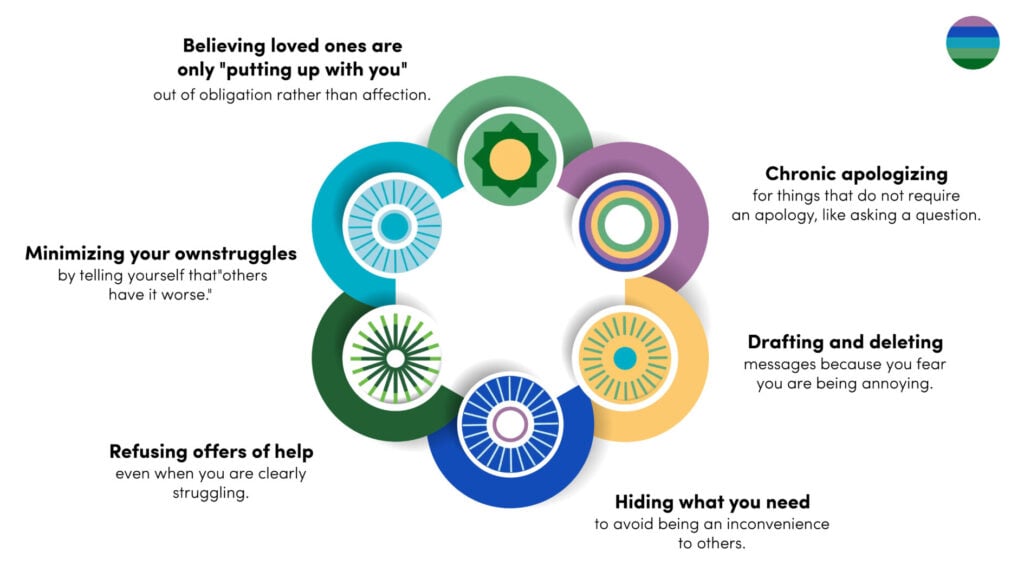
This feeling often shows up through subtle habits that you might not even realize you are doing. You may find yourself stuck in a loop of specific behaviors, such as:
- Chronic apologizing for things that do not require an apology, like asking a question.
- Drafting and deleting messages because you fear you are being annoying.
- Hiding what you need to avoid being an inconvenience to others.
- Refusing offers of help even when you are clearly struggling.
- Minimizing your own struggles by telling yourself that “others have it worse.”
- Believing loved ones are only “putting up with you” out of obligation rather than affection.
Recognizing these signs is an important step because it helps you see that these habits are not just “personality traits.” They are responses to an underlying emotional state. To begin healing, we have to look at the specific reasons why this feeling shows up in the first place.
Why This Feeling Shows Up
Most of the time, this feeling “I am a burden” grows from one of three places: your mental health, your history, or your current life circumstances.
A symptom asking for attention
Often, the belief that I am “too much” for others is a direct symptom of an underlying mental health condition. Depression is particularly skilled at telling the lie that your loved ones would be better off without you. Anxiety can cause you to catastrophize every small request, making you feel as though a simple favor will ruin a relationship.
If you live with conditions like OCD, PTSD, or Borderline Personality Disorder, your brain may be hyper-vigilant about how others perceive you. In these cases, the feeling of being a burden is not a reflection of your relationships but a side effect of the heavy emotional lifting you do every day.
Patterns from the past
Many people who struggle with this feeling learned to stay small a long time ago. If you grew up as the “easy child” or found yourself in a position where you had to care for your parents’ emotions, you may have learned that having needs is a risk. When a child’s struggles are met with frustration or neglect, they often develop an internal rule that says being a person with problems is an inconvenience.
In adulthood, this can show up as an anxious attachment style, where you fear that needing help will drive people away. It can also lead to an avoidant style, where you believe that needing anyone at all is a weakness. You are essentially repeating a survival strategy you used as a child to stay safe.
The weight of life transitions
Sometimes, the feeling of being a burden spikes when your reality changes. Major life transitions often require us to lean on others more than we are used to, which can trigger intense guilt. You might feel this more acutely during:
- Chronic illness or pain: When your physical capacity changes and you require more daily support.
- Job loss or financial shifts: When you feel a sense of “debt” toward a partner or family member.
- New parenthood: The exhaustion of early parenting can make you feel like you have nothing left to give others.
- Aging or grief: Periods where you naturally require more emotional or physical care.
In these moments, you are not a burden. You are simply a human being navigating a season that requires more support. The ground beneath you has moved, and it is natural to need a hand to stay steady.
The Reality Check: Why Your Brain is Lying to You
The most important truth about feeling like a burden is that it is almost never a shared reality. While you may feel like you have a heavy weight to carry, research consistently shows a surprising disconnect between how you see yourself and how your loved ones see you. Studies involving caregivers and friends show that supporting someone through a difficult time often leads to a greater sense of meaning and connection. To them, your vulnerability is not a chore to be completed: it is an opportunity for deeper connection. When you reach out, you are not just taking their time. You are giving them the chance to show up for someone they care about.
This feeling is so persuasive because it creates a self-fulfilling cycle known as the burden loop. It begins with the thought that you are “too much,” which leads you to pull away or hide your struggles. This withdrawal results in fewer connections, which then makes you feel more isolated. Without that connection to ground you, your brain treats the silence as proof that you were right to stay small. It is a painful irony where the act of trying to protect your loved ones by withdrawing actually makes you feel worse and reinforces your distorted self-view. Breaking this cycle requires recognizing that your feelings are a response to your internal stress, not a factual report on how much your friends and family value your presence.
When This Feeling Needs Urgent Attention

While feeling like a burden is a common experience, it can sometimes cross a line into something more dangerous. In clinical research, the persistent belief that loved ones would be better off without you is a documented risk factor for suicidal ideation. It is important to pay attention if the thought of being a burden shifts from a source of guilt to a reason to give up.
If you are experiencing these thoughts, please reach out for help right away by calling or texting 988 or contacting your local emergency resources.
How to Start Taking Up Space Again

Understanding why you feel like a burden is significant, but shifting that feeling requires active practice. Because this belief is often deeply rooted in your nervous system, healing happens through small, consistent actions that prove to your brain that you are safe and worthy of support.
Right now, when the thought hits
If you find yourself stuck in a “burden spiral” today, start with a technique called cognitive defusion. Instead of saying “I am a burden,” try saying “I am noticing the thought that I am a burden.” This subtle shift helps you realize that the thought is just a piece of internal weather, not a permanent fact. From there, try the friend reversal. Ask yourself what you would say to a dear friend if they told you they felt like a weight on you. You would likely meet them with compassion rather than frustration. Finally, try a small reality test. Text a person you trust with a simple, honest check-in. Notice their actual response, which is almost always warmer and more welcoming than the one your brain predicted.
Looking toward the future
For deeper, long-term change, professional support can be incredibly effective. Different types of therapy offer different tools for this journey. Cognitive Behavioral Therapy (CBT) can help you dismantle the thought patterns behind the feeling, while Dialectical Behavior Therapy (DBT) is excellent for building distress tolerance and improving relationships. If your feeling of being a burden stems from childhood experiences, trauma-focused work like EMDR can help address those roots. In some cases, medication can also be a helpful tool to lower the volume of the underlying anxiety or depression driving the distortion.
The most important thing to remember is that this feeling is not a fixed part of who you are. It is a response to your history and health, and it responds to treatment. You can learn to live a life where you feel like a person to be loved, not a problem to be solved.
When to Seek Professional Support

If the feeling of being a burden has become a constant companion, it may be time to bring a professional into your corner. It is particularly important to reach out if you notice a persistent low mood, a desire to withdraw from the people you love, or intrusive thoughts that interfere with your safety and daily life. Whether you prefer in-person sessions, online therapy, or specialized group support, there are accessible options designed to meet you exactly where you are.
If you are ready to stop shrinking and begin healing, reach out to Therapy Austin today to schedule a session. Reaching out for support is not an act of being a burden: it is the ultimate evidence that you are not what this feeling tells you you are.