







You agreed to take on a project you didn’t have time for. You answered a late-night call from someone who always leaves you drained. You said “it’s fine” when it wasn’t.
If any of this sounds familiar, you are not failing at relationships. You are simply running without a map for your own limits.
Setting boundaries is one of the most misunderstood ideas in mental health. It can sound cold, even selfish, in a way that makes a naturally caring person hesitant to try. But a boundary isn’t a wall you build to keep people out. It’s a line you draw to protect what’s inside: your energy, your values, your sense of self.
The good news is that boundaries are a skill. And like any skill, they can be learned.
What Are Personal Boundaries, Really?
A personal boundary is a limit that defines where you end and someone else begins. It communicates what you are available for and what you are not, whether that involves your time, your emotional energy, your physical space, or your mental wellbeing.
Boundaries are not punishments. They are not passive-aggressive tactics, ultimatums, or signs that a relationship is falling apart. In fact, research consistently shows that people with clearly defined boundaries tend to experience higher self-respect, lower resentment, and deeper, more sustainable connections with others.
The confusion often comes from how boundaries were modeled, or not modeled, in our earliest relationships. If you grew up in a home where expressing a need was seen as selfish or inconvenient, the idea of drawing a line around yourself can feel genuinely threatening. That is not a character flaw. It is a learned pattern, and learned patterns can change.
Why Is It So Hard to Set Boundaries?
For many people, the difficulty isn’t about not knowing what to say. It goes much deeper than that.
People-pleasing, sometimes called the “fawn” response, is a survival strategy that starts in childhood. When a child learns that keeping others happy is the safest way to move through the world, that habit doesn’t disappear in adulthood. It shows up as chronic overcommitment, difficulty saying no without elaborate apology, and a persistent fear that having needs will cost you someone’s love or approval.
Attachment styles also play a significant role. People with an anxious attachment style often fear that asserting a limit will lead to abandonment. Those with an avoidant style may struggle to communicate needs because they learned early on to suppress them entirely.
If you frequently find yourself feeling like a burden to others, it is worth exploring whether that belief is quietly shaping how freely you ask for what you need.
Cultural and family messages matter too. For many people navigating expectations around duty, gender roles, or family loyalty, setting a boundary can feel like a betrayal of identity. Therapy provides a space to untangle these messages and define what healthy limits actually look like in your life, not based on someone else’s expectations.
The Different Types of Boundaries
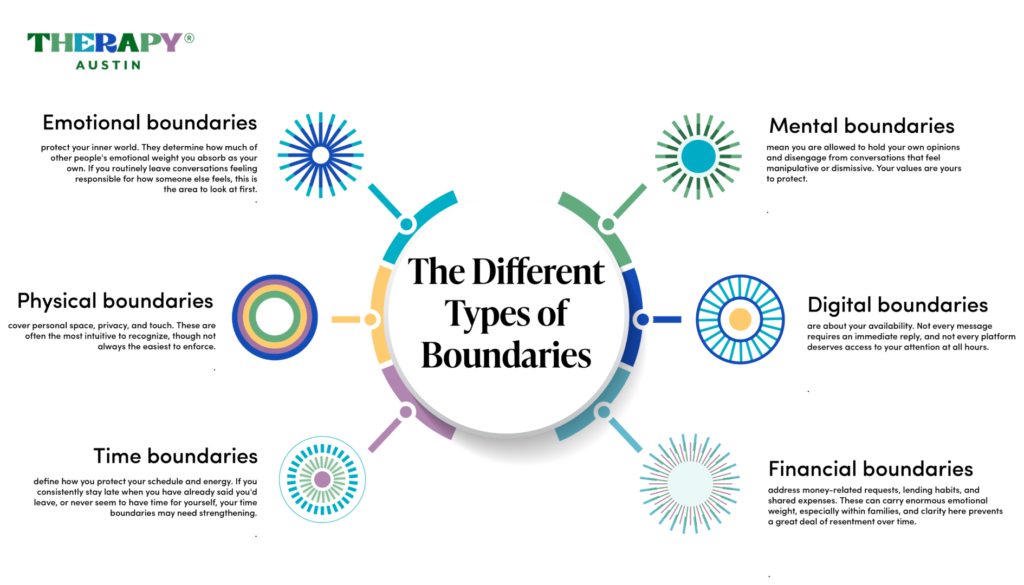
Boundaries are not one-size-fits-all. Understanding the different categories helps you identify where your own limits may need the most attention.
Emotional boundaries protect your inner world. They determine how much of other people’s emotional weight you absorb as your own. If you routinely leave conversations feeling responsible for how someone else feels, this is the area to look at first.
Physical boundaries cover personal space, privacy, and touch. These are often the most intuitive to recognize, though not always the easiest to enforce.
Time boundaries define how you protect your schedule and energy. If you consistently stay late when you have already said you’d leave, or never seem to have time for yourself, your time boundaries may need strengthening.
Mental and intellectual boundaries mean you are allowed to hold your own opinions and disengage from conversations that feel manipulative or dismissive. Your values are yours to protect.
Digital boundaries are about your availability. Not every message requires an immediate reply, and not every platform deserves access to your attention at all hours.
Financial boundaries address money-related requests, lending habits, and shared expenses. These can carry enormous emotional weight, especially within families, and clarity here prevents a great deal of resentment over time.
Signs You May Need To Redefine Boundaries
The need for boundaries doesn’t always announce itself directly. More often, it shows up in how you feel after spending time with certain people or situations.
Some of the most common signals include:
- Saying yes when every part of you wants to say no
- Feeling responsible for managing other people’s emotions
- Dreading certain interactions before they even begin
- Doing things out of obligation rather than genuine willingness
- Feeling chronically depleted after time with specific people
- Resentment that builds quietly and colors every interaction
That last one deserves particular attention. Chronic resentment is one of the clearest signs that something you need has been going unaddressed for a long time. As we cover in our guide on conflict management strategies for couples, resentment that isn’t addressed early tends to grow into something far harder to repair.
How to Set Healthy Boundaries: A Step-by-Step Guide
Knowing you need boundaries is one thing. Knowing how to actually draw them is another. Here is a process that builds from the inside out.
Start by noticing where your body is already telling you something. Resentment, dread, and exhaustion are not random. They tend to cluster around the same situations and the same people. That pattern is your starting point.
From there, get clear on what you are actually protecting. A boundary that isn’t grounded in a value won’t hold. Ask yourself: what is this limit defending? Your time? Your emotional capacity? Your sense of self-respect? The clearer your why, the easier the conversation becomes.
Once you know what you need, start small. Practice with a colleague or acquaintance before tackling the most emotionally charged relationship in your life. The skill is the same. The emotional stakes are much lower. Build the muscle before you need it most.
When you are ready to speak up, keep your language simple and direct. You do not owe anyone a lengthy explanation. “I’m not available for calls after 8 PM” is a complete sentence. So is “I’m not able to take that on right now.”
Expect some pushback. People who are used to having unlimited access to you may react with surprise, hurt, or frustration. Their discomfort is real. It does not mean you have done something wrong.
Finally, hold the line. A boundary that disappears under pressure isn’t a boundary yet. Consistency is what turns a stated limit into a lived reality.
How to Communicate a Boundary Without the Guilt
Guilt is the most common reason people abandon a boundary the moment after they set it. But it is worth understanding what that guilt actually is.
In most cases, it isn’t guilt in the moral sense. It’s the discomfort. The feeling of doing something unfamiliar that has long operated a certain way. Guilt implies you’ve done something wrong. Discomfort means you’ve done something new.
That discomfort fades with repetition. The first time you decline a request without apologizing, it will feel enormous. By the tenth time, it will feel like breathing.
A useful reframe: think about what you would say to a close friend who told you they were exhausted, overextended, and afraid to ask for less. You would almost certainly tell them that having limits is not only acceptable but also necessary. You deserve that same response from yourself.
How Therapy at Therapy Austin Can Help
Setting boundaries sounds straightforward on paper. In practice, it can bring up years of learned patterns, deep-seated guilt, and fears that are hard to work through alone. This is where professional support makes a real difference. At Therapy Austin, our therapists use several evidence-based approaches specifically suited to this kind of work.
Cognitive Behavioral Therapy (CBT) helps you identify and restructure the distorted thoughts that fuel boundary-related guilt, thoughts like “if I say no, they will leave” or “my needs matter less than everyone else’s.”
Dialectical Behavior Therapy (DBT) offers specific interpersonal effectiveness tools, including the DEAR MAN framework, which gives you a structured and respectful way to assert a need or decline a request without damaging the relationship.
Somatic therapy works at the level of the body. It helps you recognize the physical signals that appear before you have even consciously noticed a boundary is being crossed: a tight chest, a held breath, a sinking feeling in the stomach. Our somatic therapy services in Austin are particularly helpful for people whose boundary difficulties are rooted in trauma or chronic nervous system dysregulation.
Acceptance and Commitment Therapy (ACT) grounds boundary work in personal values. When you are clear on what genuinely matters to you, saying no to what doesn’t align becomes less of a confrontation and more of a natural act of self-direction.
You Are Allowed to Take Up Space

The belief that your needs are a burden, that your limits are an inconvenience, that saying no will cost you love is one of the quietest and most persistent forms of suffering a person can carry. It does not have to be permanent.
Setting healthy boundaries isn’t about becoming someone who cares less. It’s about becoming someone who can sustain their care without disappearing in the process. The relationships in your life that are worth having will not only survive your limits. They will become richer because of them.
If you are ready to explore this work with professional support, our therapists at Therapy Austin are here to help. You can meet our team, explore our individual therapy services, or get started with online therapy if you prefer to work from home.