







You’re lying in bed, fully awake at 3 AM, replaying a conversation from five years ago. Your brain keeps spinning on a comment someone made, a mistake you made, or a moment you wish you could rewind. You’ve already moved forward in your life-you’ve changed jobs, ended relationships, moved across the country, but your mind keeps looping back to yesterday like a song stuck on repeat.
If you’ve ever found yourself trapped in this kind of rumination, you’re not broken. You’re not weak. You’re experiencing something that millions of people struggle with: the inability to stop thinking about the past. The truth is, your brain is doing exactly what it was built to do: protect you. The problem is that sometimes it overprotects, turning memories into mental prisons.
The good news? This is a learned pattern, and learned patterns can be unlearned.

Why Your Brain Gets Stuck on the Past
Your brain didn’t evolve to make you happy. It evolved to keep you alive. In our evolutionary past, remembering threats meant survival. The person who forgot where the danger lived didn’t pass on their genes. Over thousands of years, our brains have become expert threat detectors, which means they naturally prioritize negative experiences.
This is called negativity bias, and it’s one of the most powerful forces shaping your thoughts. Your brain allocates more mental resources to negative information than to positive. A single criticism outweighs five compliments. A mistake you made five years ago carries more weight than a hundred successes.
For some people, past thinking is a symptom of something deeper. If you’ve experienced trauma, your brain may be stuck in hypervigilance mode. If you live with depression, rumination often becomes a way your brain tries to “solve” painful feelings. Anxiety can turn past events into evidence of future danger.
The important thing to understand: there is nothing wrong with you for getting stuck in the past. Your brain is doing what it’s designed to do. The goal isn’t to fight your brain; it’s to gently redirect it.
Rumination vs. Healthy Reflection
Not all thinking about the past is harmful. There’s a significant difference between rumination and reflection.
Healthy reflection is purposeful thinking about the past. You consider what happened, extract a lesson, and move forward with a new understanding. It’s time-bound and feels productive. You reflect on a relationship and think, “I learned that I need better communication,” and that insight shapes how you move forward.
Rumination is repetitive, circular thinking that leads nowhere. You’re replaying the same thoughts over and over without new insights. It feels stuck and exhausting. You might spend an hour replaying a conversation and end up feeling worse, with nothing gained.
Here’s the key: Reflection asks, “What can I learn?” Rumination asks, “What did I do wrong?” Reflection has closure. Rumination is endless.
If you find yourself ruminating, it often means one of three things is happening:
First, you’re dealing with a mental health symptom that needs attention. Depression and anxiety both come with their own flavors of rumination. If rumination is persistent and interfering with your life, it’s worth exploring whether there’s an underlying condition that would benefit from professional support.
Second, you may be working through an unresolved feeling or experience. Sometimes your brain won’t let go of the past because something about it feels incomplete. You never got an apology, never had closure, never fully processed what happened. In these cases, rumination is your brain’s way of trying to solve an unsolvable problem.
Third, rumination might be a habit. If you’ve spent years replaying past events, your brain has literally built neural pathways around this pattern. Breaking it requires not just understanding why you do it, but also practicing new ways of thinking.
Five Practical Techniques to Stop Ruminating
Now that you understand why your brain gets stuck, let’s talk about what you can actually do about it.
1. The 5-4-3-2-1 Grounding Exercise
This technique anchors you to your present environment by engaging all five senses:
- Look around and identify 5 things you can see
- Notice 4 things you can physically feel
- Listen for 3 things you can hear
- Identify 2 things you can smell
- Notice 1 thing you can taste
This works because rumination is a time-travel problem. Your mind is in the past. Grounding brings you back to the only moment where you have power: right now. Research consistently shows that grounding exercises reduce anxiety and interrupt intrusive thoughts.
2. Scheduled Worry Time
This sounds counterintuitive, but it works. Instead of trying to suppress the thought, schedule a specific time each day to consciously think about it. Here’s how:
- Choose a 15-20 minute window daily, preferably in the afternoon
- When you catch yourself ruminating outside this time, write down the thought and tell yourself, “I’ll think about this at 3 PM“
- During your scheduled time, sit with the thought without fighting it
- When the time is up, consciously close that mental door
When your brain knows it has permission to think about something at a designated time, it’s less likely to hijack your attention throughout the day. This paradoxically reduces overall rumination.
3. Cognitive Defusion (Separating from Your Thoughts)
This technique from Acceptance and Commitment Therapy creates distance between you and your thoughts. Instead of believing your thoughts are facts, you observe them as just thoughts, mental events that come and go.
Practice this: When a ruminating thought appears, instead of “I am a failure,” try: “I’m having the thought that I’m a failure.” Even better: “My mind is producing the thought that I’m a failure.”
Observe the thought like a cloud passing across the sky. You don’t grab it or push it away; you just notice it and let it drift. This shift from “This thought is true” to “This is a thought my brain is having” changes everything.
4. Expressive Writing
Write about the past event or feeling for 15-20 minutes without censoring yourself. Focus on getting emotions out, not grammar or structure. Don’t worry about anyone reading it.
Write about what you felt then and what you feel now. Let yourself be angry, sad, or regretful. When the timer goes off, you can read it, tear it up, delete it, or even burn it for ritual closure.
Research on expressive writing shows it significantly reduces rumination and anxiety. Writing helps your brain organize chaotic feelings into a narrative, creating closure and release.
5. Movement and Somatic Release
Use physical activity to process and release the emotional charge around past memories. This could be walking, dancing, yoga, running, or even shaking your body.
Move with intention. Pair movement with breathwork: inhale for a count of 4, exhale for a count of 6. This signals to your nervous system that you are safe right now.
Trauma and intense emotions don’t just live in your mind; they live in your body. When you move your body, you shift your nervous system state and process stuck energy.
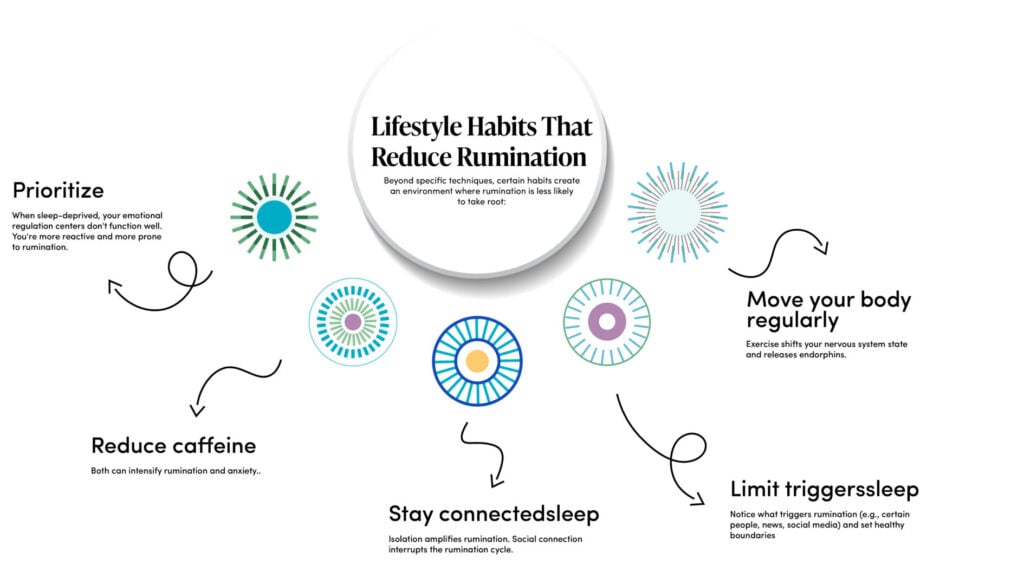
Lifestyle Habits That Reduce Rumination
Beyond specific techniques, certain habits create an environment where rumination is less likely to take root:
- Prioritize sleep: When sleep-deprived, your emotional regulation centers don’t function well. You’re more reactive and more prone to rumination.
- Reduce caffeine and alcohol: Both can intensify rumination and anxiety.
- Stay connected: Isolation amplifies rumination. Social connection interrupts the rumination cycle.
- Limit triggers: Notice what triggers rumination (e.g., certain people, news, social media) and set healthy boundaries.
- Move your body regularly: Exercise shifts your nervous system state and releases endorphins.
When to Seek Professional Support
The techniques in this article can be incredibly helpful. But some types of rumination benefit tremendously from professional support.
For instance, if you’re living with depression or anxiety, rumination is often a symptom. Cognitive Behavioral Therapy (CBT) is particularly effective for breaking rumination patterns. A therapist helps you identify the underlying thoughts feeding rumination and practice new patterns until they become automatic.
If you’re dealing with trauma, trauma-focused therapies like EMDR can help your brain process traumatic memories in a way that reduces their emotional charge and ability to intrude on your present.
If rumination is tied to perfectionism or shame, Acceptance and Commitment Therapy (ACT) and somatic therapy can be particularly helpful. These approaches help you develop a different relationship with difficult emotions rather than trying to eliminate them.
If past events are affecting your relationships, couples therapy can help. Sometimes we ruminate because unresolved relationship issues keep our nervous systems on high alert.
At Therapy Austin, we work with clients struggling with rumination using evidence-based approaches. Whether it’s CBT for anxiety-driven rumination, somatic therapy for trauma, or mindfulness-based approaches to build long-term resilience, we meet you where you are.
You Can Break Free from This
The groove your brain has worn into the past is deep, but it’s not immovable. Rumination responds to treatment. It responds to practice. It responds to patience and self-compassion.
You’re not failing because your mind keeps returning to the past. You’re simply navigating a common psychological challenge that millions of people face.
Pick one technique from this article that resonates with you. Practice it this week when you notice rumination. Notice what shifts. Then, if that feels helpful, add another tool to your toolkit.
If self-help techniques aren’t enough, please reach out for professional support. You don’t have to do this alone.
The past doesn’t have to be a prison. With the right tools and support, it can become exactly what it should be: a teacher, not a trap.