







Do you ever react to something and immediately wish you had handled it differently? Maybe a small comment makes you defensive, a disagreement quickly turns into anger, or a delayed text leaves you feeling anxious and assuming the worst. When emotions take over before you have time to think, it can feel like you’re reacting on autopilot. This is often what emotional reactivity looks like.
Being emotionally reactive does not mean your feelings are wrong or that you need to stop feeling deeply. The goal is not to become emotionless. Instead, learning to be less emotionally reactive means creating a little more space between what you feel and what you do next. That space can help you understand what’s happening, calm your body, and choose a response that better reflects what you actually want to say or do.
In this guide, we’ll explore therapy-informed techniques that can help you build that skill.
What Does It Mean to Be Emotionally Reactive?
Emotional reactivity means having an immediate emotional response to something that feels upsetting, threatening, disappointing, or overwhelming. The reaction can happen so quickly that you respond before you have had a chance to understand what you are feeling or consider what you want to do next.
For example, you might take criticism personally and become defensive, feel angry during a disagreement, assume the worst when someone does not respond to your message, or send an angry text that you regret once you have calmed down. You might also shut down, withdraw, or stop communicating when you feel hurt.
The difference is often what happens between the trigger and your response:
Trigger → Automatic Reaction
versus
Trigger → Pause → Awareness → Intentional Response
That pause gives you an opportunity to notice your emotions, identify the thoughts behind them, and decide how you want to respond.
Emotional reactivity is not simply a matter of having a bad temper or being too sensitive. Stress, anxiety, past experiences, learned coping patterns, relationship dynamics, and feeling overwhelmed can all influence how quickly and intensely you react. The good news is that emotional regulation is a skill. With practice, you can learn to recognize your triggers, slow your reactions, and respond in ways that better align with your intentions.
5 Therapy Techniques to Be Less Emotionally Reactive
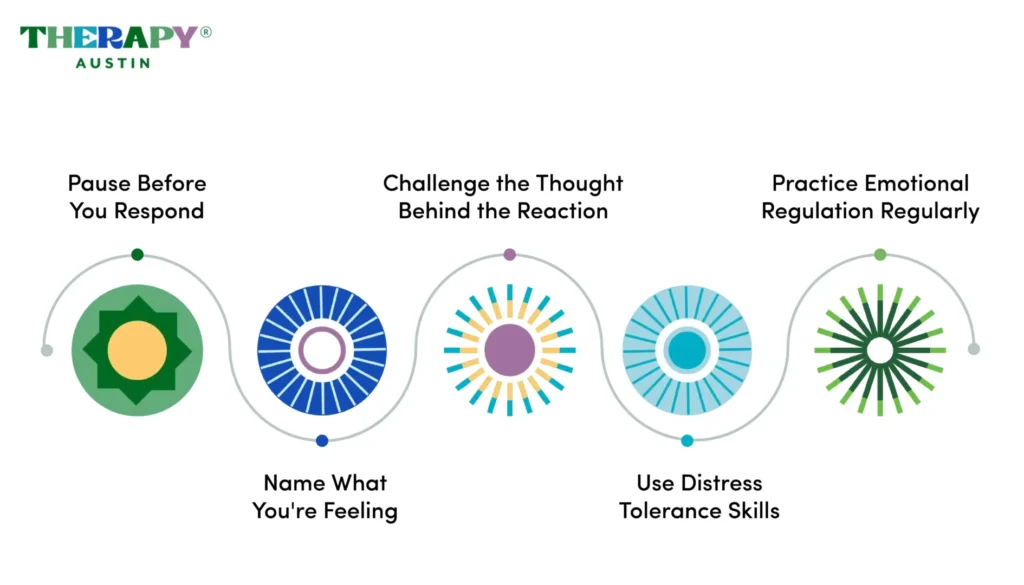
Becoming less emotionally reactive isn’t about learning to suppress anger, anxiety, hurt, or other difficult emotions. Instead, therapy often focuses on helping you recognize what is happening sooner, tolerate uncomfortable feelings, and make more deliberate choices about how you respond. The following five techniques can help you start building that space between an emotional trigger and your reaction.
1. Pause Before You Respond
When something triggers a strong emotion, your first impulse may be to defend yourself, argue, send a message, walk away, yell, or shut down. Acting on that impulse can provide temporary relief, but it may also escalate the situation or leave you wishing you had responded differently.
A deliberate pause gives you time to let the initial intensity settle before deciding what to do. Start by taking several slow breaths or counting to 10. If you’re responding to a message, put your phone down and give yourself time before replying. During an argument, you might say, I need a few minutes to process this before we continue.
The goal isn’t to ignore the problem. A healthy pause means taking enough time to regulate yourself and then returning to the conversation when you’re ready to engage more calmly. Avoiding the conversation altogether may leave the underlying issue unresolved.
With practice, even a brief pause can help turn an automatic reaction into a more intentional response.
2. Name What You’re Feeling
When you’re emotionally activated, saying I’m upset may not tell you much about what’s actually happening. Learning to identify the specific emotion underneath your reaction can make it easier to understand what you need.
You might be angry, but underneath the anger you could also feel hurt, rejected, embarrassed, afraid, anxious, disappointed, or overwhelmed. Naming the emotion gives you more information about what is driving your response.
Try asking yourself three questions:
What happened? What am I feeling? What do I need?
For example, imagine a friend cancels plans with you. Your first thought might be, They don’t care about me. You may notice that you’re becoming irritated and want to respond coldly. But after pausing, you might recognize that the stronger emotion is actually hurt or rejection. What you need may be reassurance, connection, or simply time to process the disappointment.
This process is sometimes called emotion labeling. Rather than judging the emotion or acting on it immediately, you’re identifying it more accurately. That awareness can make it easier to decide what to do next, rather than letting the emotion make the decision for you.
3. Challenge the Thought Behind the Reaction
Sometimes the intensity of an emotional reaction comes not only from what happened but from what you immediately tell yourself the situation means. Cognitive Behavioral Therapy (CBT) uses this connection to help people examine automatic thoughts and develop more balanced ways of interpreting difficult situations.
One useful framework is:
Situation → Thought → Emotion → Behavior
For example, your partner doesn’t respond to your messages for several hours.
Situation: Your partner hasn’t responded.
Thought: “They’re angry with me.”
Emotion: Anxiety and insecurity.
Reaction: You send several angry messages.
CBT encourages you to slow down and examine the thought before acting on it. Ask yourself:
- What evidence supports this thought?
- What evidence doesn’t support it?
- Am I assuming I know what someone else is thinking?
- Is there another possible explanation?
- Am I jumping to the worst-case scenario?
- What would I tell a friend in the same situation?
The goal isn’t to force yourself to think positively or convince yourself that everything is fine. It’s to move from an automatic assumption to a more balanced interpretation. When your interpretation becomes less extreme, your emotional response may become easier to manage as well.
4. Use Distress-Tolerance Skills
When emotions become extremely intense, trying to reason through the situation may not work right away. Your body may already be in a heightened state, making it difficult to think clearly or communicate calmly. This is where distress-tolerance skills, commonly taught in Dialectical Behavior Therapy (DBT), can help.
The first step is to bring the intensity down before trying to solve the problem.
You might take several slow breaths, focus on the five senses, take a short walk, practice progressive muscle relaxation, or use cool water on your face. If you’re in the middle of an escalating argument, temporarily stepping away can also give your body time to settle.
A simple DBT-inspired framework is STOP:
S — Stop: Don’t act on the immediate impulse.
T — Take a step back: Create some physical or emotional distance from the situation.
O — Observe: Notice your emotions, thoughts, physical sensations, and surroundings.
P — Proceed mindfully: Decide what response is most helpful rather than simply following the strongest impulse.
These skills aren’t about avoiding difficult emotions. They help you tolerate the emotion long enough to respond without making the situation worse.
5. Practice Emotional Regulation Regularly
It’s difficult to develop emotional regulation skills only when you’re already overwhelmed. Like any other skill, becoming less emotionally reactive takes practice even when you’re calm.
Start by paying attention to patterns in your emotional responses. Mindfulness can help you notice thoughts and feelings without immediately acting on them. Journaling can help you identify recurring triggers, while healthy sleep, regular physical activity, and self-compassion can support your ability to cope with stress.
You can also practice communication skills before you’re in the middle of a conflict. If certain situations repeatedly trigger strong reactions, discussing these patterns with a therapist can help you understand their origins and develop strategies that fit your needs.
After a difficult emotional situation, try a short reflection:
- What happened?
- What did I feel?
- What did I think?
- How did I react?
- What could I try next time?
The purpose isn’t to criticize yourself for reacting. It’s to learn from the experience. Over time, noticing these patterns can help you recognize triggers earlier, create more space before reacting, and respond in ways that better reflect the person you want to be.
How to Be Less Reactive During an Argument
Arguments can make it especially difficult to think clearly. When emotions start rising, try to catch the reaction before it takes over. First, notice your body’s warning signs. A racing heart, clenched jaw, tight muscles, rapid breathing, or feeling unusually hot can signal that you are becoming overwhelmed.
1. Pause before escalating: If you notice these signs, slow down rather than continuing the argument. You do not have to solve the problem immediately.
2. Regulate your body: Take several slow breaths, ground yourself by noticing what you can see and hear, or step away briefly if you need more space.
3. Identify what is underneath the anger: Ask yourself whether you are angry or actually feeling hurt, afraid, embarrassed, or rejected. Understanding the underlying emotion can change how you approach the conversation.
4. Communicate instead of attacking: Rather than blaming or criticizing, use an I statement. For example, explain that you are feeling overwhelmed and need a few minutes before continuing the conversation.
5. Come back when you are ready: Taking a break should give you time to regulate yourself, not punish, ignore, or shut out the other person. When you are calmer, return to the conversation and address the issue with greater intention. Over time, this process can help arguments become less reactive and more productive.
When Can Therapy Help With Emotional Reactivity?
Learning to pause, identify your emotions, and manage difficult feelings can make a meaningful difference. But sometimes emotional reactions remain intense or difficult to control, even when you are trying to change them. This is when therapy may be worth considering.
Professional support can be especially helpful when emotional reactivity frequently affects your relationships, creates recurring conflict, interferes with work or daily life, or leaves you feeling significant distress after you react. Therapy can also help when strong reactions seem connected to anxiety, past experiences, trauma, or other emotional difficulties.
Different therapy approaches can address emotional reactivity in different ways. Cognitive Behavioral Therapy (CBT) can help you recognize automatic thought patterns and examine whether they are contributing to intense emotional responses. Dialectical Behavior Therapy (DBT) focuses on practical skills for emotion regulation, distress tolerance, mindfulness, and healthier interpersonal communication. Trauma-focused therapy may be helpful when certain emotional reactions are connected to traumatic experiences or unresolved responses to the past.
Emotional reactivity does not automatically mean that you have a mental health disorder. Therapy can simply provide a supportive space to understand your patterns, identify triggers, and develop healthier ways to respond when emotions feel difficult to manage.
Conclusion
Being less emotionally reactive does not mean becoming less emotional. Strong emotions are a normal part of life, and you do not need to suppress them to handle them more effectively. What can change is how you respond when those emotions become intense. By pausing before reacting, naming what you feel, challenging automatic thoughts, using distress-tolerance skills, and practicing emotional regulation regularly, you can create more space between emotion and action.
With time, that space can make it easier to respond thoughtfully rather than automatically. If emotional reactivity continues to affect your relationships, work, or daily life, therapy can help you understand your patterns and develop strategies tailored to your needs. Reaching out for support can be a meaningful step toward healthier emotional responses.